Infinite feeds strip away the normal stopping points that books, episodes, and finished tasks give you.
Without those cues, your brain stays in search mode, waiting for the next reward of novelty that might finally feel worth it.
Focus / Card lesson
Feeds feel unfinished on purpose. This lesson shows why the loop stays open and where to break it.
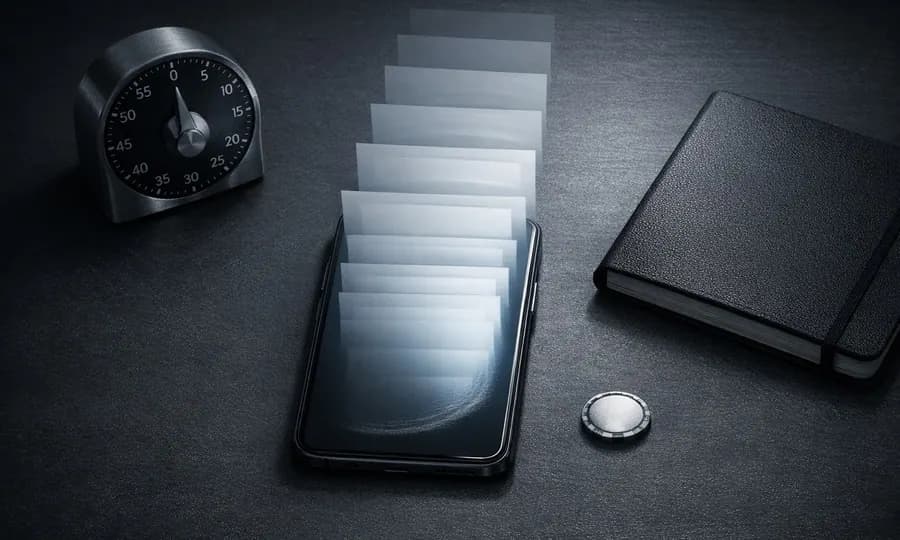
Infinite feeds strip away the normal stopping points that books, episodes, and finished tasks give you.
Without those cues, your brain stays in search mode, waiting for the next reward of novelty that might finally feel worth it.
An endless feed offers unpredictable novelty: the next post might be useful, funny, or forgettable. That resembles a variable reward schedule, though real feed use is more complicated than a lab task.
The practical problem is simpler: there is always another maybe waiting below the thumb.
Wolfram Schultz's 2016 review describes dopamine prediction-error signals as part of how the brain updates expectations after outcomes. That is not proof that one chemical explains scrolling.
The defensible point is that uncertain rewards can teach repeated checking, while the missing stop cue makes continuing easy.
Quick check
After a stretch of rapid clips and refreshes, reading or planning may feel unusually slow. That does not mean the task lost its value or your brain is damaged.
Treat the feeling as a cue to lower the input speed and give the slower task a short, clean start.
Try this
Switch your phone to grayscale in accessibility settings. When the colors lose their punch, the feed loses some of the pull too. It is a small move, but it makes the loop feel less rewarding.
Try this
Create a physical home for the phone that is not your desk and not your pocket. A drawer, shelf, or other room removes the constant visual cue that keeps the checking loop alive.
Try this
Turn off notifications except direct human communication like calls or texts. Red badges and random pings keep the loop open. Removing them gives your brain a quieter baseline to return to.
Try this
When the urge to check a feed arrives, set a 15-minute timer first. Notice whether the urge changes while you wait. If you still want to check after that, fine; the pause simply puts a choice back between the cue and the tap.
Try this
Pick one 2-hour window each day where feeds stay off-limits. The point is not perfection. The point is giving boredom somewhere to land again so deeper focus stops feeling impossible.
Key idea
The phone keeps promising relief and novelty, which is why stopping feels weirdly hard. Add friction, reduce cues, and let boredom come back online.
If this is significantly impacting your life, seek professional support.
Seeking is not the same thing as satisfaction.