Posture

What to Do When Your Back Flares

Calm a back flare with load reduction, walking, and simpler movements first.

Card lesson10 sections
Published by RebuiltLast updated: Sources visible below

A flare is the wrong time for either panic or ego*

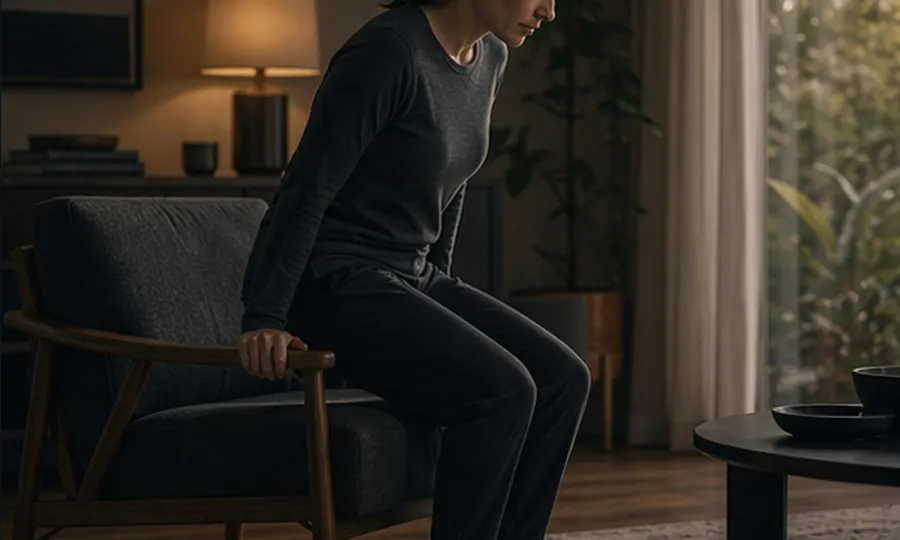
You bent to grab a bag and your lower back locked. Now half of you wants to lie flat for three days and the other half wants to stretch it hard and prove it is fine. After a bad sleep, long drive, or heavy day, a flare usually settles best with temporary load reduction, easier movement, and shorter sitting bouts.

Educational content only — not medical advice. Stop if sharp or worsening pain.

Your job is to lower the total load for a day or two

During a flare, the useful question is not "what relieves this in 10 minutes?"

It is "what keeps this from being provoked all day?" Shorter sitting, less bending under fatigue, smaller lifts, and more walking usually calm the system faster than one perfect stretch.

Guarding can become its own problem

When you move like everything might break, your muscles often stay over-braced and tired.

The win is controlled, ordinary movement again: rolling, standing, walking, and sitting down without making every transition a fight scene.

Quick check

Flare Check

What is the smartest first-day move in a normal low-back flare with no red-flag symptoms?

  1. Lift as usual so your back does not get lazy.
  2. Reduce the total load, keep moving in small doses, and avoid the positions that keep winding it up.
  3. Stay in bed and avoid walking entirely.

Exactly. A good flare plan lowers the total load for a day or two.

Try this

Cut deep bending and twisting for 24 to 72 hours

Use hip hinges, split the task up, or ask for help with the awkward lift. This is not forever. It is just how you stop feeding the flare while it settles.

Try this

Use 5-minute walks as your reset button

Walk once in the morning, once at lunch, once late afternoon, and once in the evening if you can. You are not trying to train. You are trying to keep the system from stiffening further.

Try this

Cap sitting blocks at 20 to 30 minutes

Stand, walk to the kitchen, or do one lap around the room before you sit again. If you have to work, that timer matters more than your chair brand for the next couple of days.

Try this

Keep one relief setup ready

Have a side-lying pillow setup or a legs-on-chair position ready to use for 5 to 10 minutes after long sitting or commuting. Make it easy enough that you actually use it before the pain spikes.

Try this

Judge the next morning, not the next 5 minutes

Some movement hurts a little while you do it but leaves you looser later. Some looks harmless and leaves you worse the next day. Use the next-morning result as your main signal.

Key idea

What to remember

A back flare usually wants less total load, more ordinary movement, and fewer all-or-nothing decisions. Calm the day down first. Then build back up.

Stop any exercise that causes sharp or worsening pain.

The best flare plan is the one you can repeat for 48 hours without making the pain angrier.

Sources

  1. WHO — Low back pain
  2. MedlinePlus — Back Pain
  3. Qaseem A et al. (2017) — Noninvasive Treatments for Acute, Subacute, and Chronic Low Back Pain

Further reading

  • WHO — Low back pain
  • ACP — Guideline for nonradicular low back pain