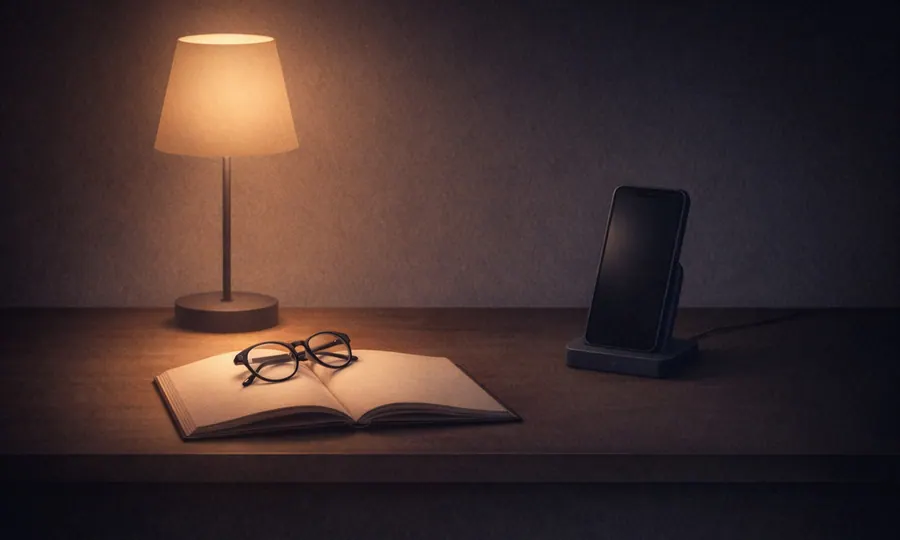
The overhead light is bright. The screen is bright. Your body may be tired, but the light has not changed yet.
The room still says daytime
Melatonin is the sleep-start signal
Melatonin is a hormone released by the pineal gland that signals sleep is approaching. Duffy and Wright (2005) showed that the timing of melatonin onset, called DLMO, is strongly influenced by evening light exposure. Bright evening light delays DLMO, which pushes sleep later than intended.
*Dimming the room is not a habit hack. It is removing the signal that tells the clock to stay on.*
Warm mode is still bright
A warmer screen can reduce some blue light, but it does not make a bright room dim. West et al. (2011) and Chang et al. (2015) support lowering evening light, not relying on the filter alone.
Quick check
The hormone quiz
Quick check
The filtering quiz
Try this
Dim one light before bed
Turn off the bright overhead light or lower the strongest screen. One clear change is enough for tonight.
Try this
Build a short low-stimulation allowed list
Decide in advance what is allowed late: e-reader, notes, calm audio, a physical book. Keep feeds, news, short video, and argument-prone chats off the list. The list makes the decision before you are tired.
Try this
Keep the late choice low-stimulation
When the room is dim, choose one thing from the allowed list and keep it simple. The aim is to stop opening new branches before bed.
Key idea
Dim the room before you ask the brain to settle
Dim the room before you ask the brain to settle.