Ultra-processed food is not just normal food in a package.
It is often engineered to be fast, soft, salty, sweet, fatty, cheap, and easy to keep eating.
Nutrition / Card lesson
Ultra-processed foods are easy to overeat because they are designed for speed, softness, and low stopping power.
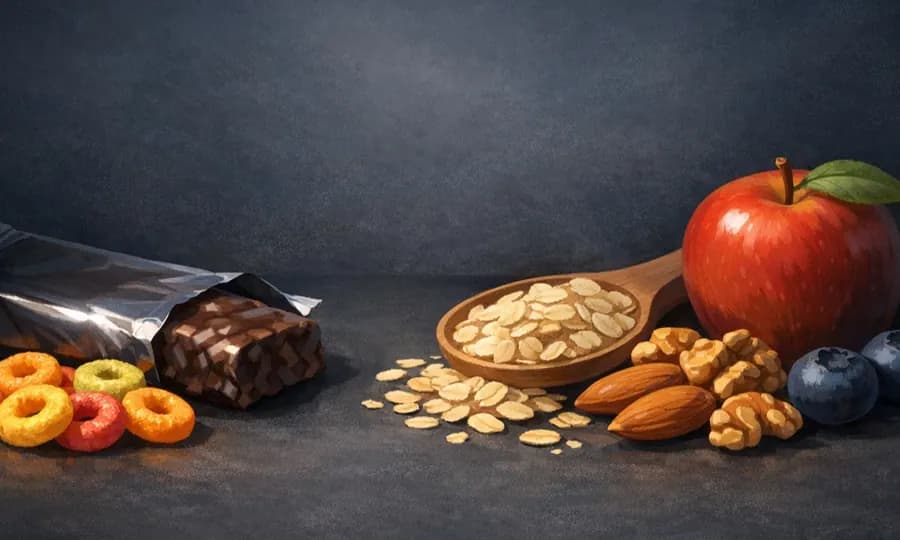
Ultra-processed food is not just normal food in a package.
It is often engineered to be fast, soft, salty, sweet, fatty, cheap, and easy to keep eating.
Soft texture, strong flavour, low fibre, and easy access can make it harder to notice fullness.
That does not make you weak. It means the food is doing its job.
Cardoso et al. (2026) found that higher ultra-processed food intake was linked with lower attention scores in middle-aged and older adults.
This was cross-sectional, so do not present it as proof of causation.
Association is not causation, but the attention signal is worth respecting.
Quick check
Try this
Do not obsess over whether a label has five ingredients or seven. Ask a better question: is this mostly recognizable food, or mostly refined stuff and flavor engineering? Plain yogurt, oats, and canned beans can have short boring labels. A bar with a long list of sweeteners, isolates, and flavoring is usually telling a different story.
Try this
Do not try to purge your kitchen in one dramatic moment. Replace the products you eat most often: breakfast cereal, flavored yogurt, snack bars, pastries, crisps, sweet drinks. One stronger everyday default matters more than one ideal shopping trip.
Try this
If you are going to eat something sweet or very processed, pair it with something that actually slows the hit: yogurt, fruit, nuts, milk, jerky, or a proper meal.
The point is to stop one engineered snack from turning into a grazing spiral.
Try this
Watch for the products that pretend to be healthy while still working like dessert: granola clusters, protein cookies, fruit gummies, breakfast bars, sweetened yogurt drinks. If it markets itself like a health product but eats like candy, treat it like candy.
Try this
You do not control every airport, office, or party. You do control what sits in your kitchen most days. If home is stocked with easier defaults, random cravings have less room to turn into routine. Environment wins more than discipline here.
Try this
Do not try to fix your whole diet in one day.
Pick one repeat item and build a better default: crisps to nuts and fruit, sugary drink to water plus flavour, pastry breakfast to yoghurt and oats.
Key idea
Ultra-processed food is hard to stop because it is built for speed, reward, and repeat. Better defaults, better pairing, and fewer fake-health products matter more than one flawless food day.
If it is hard to stop, that is part of the design.