That flat, irritable, restless feeling after too much stimulation is not random.
Fast rewards often feel great on the front end and oddly disappointing on the back end. That contrast is part of why the loop keeps asking for another hit.
Craving & Reward / Card lesson
Big stimulation spikes can leave ordinary life feeling flatter and cravings louder for a while.
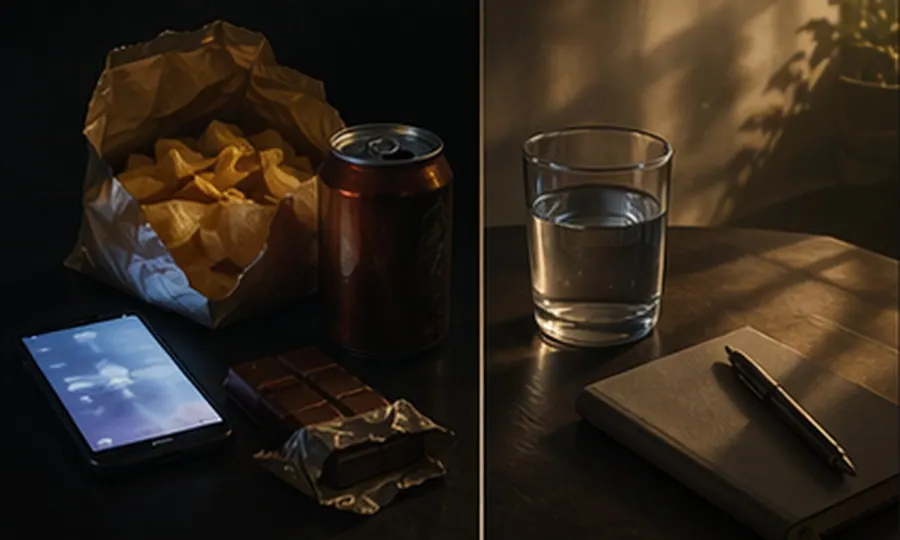
That flat, irritable, restless feeling after too much stimulation is not random.
Fast rewards often feel great on the front end and oddly disappointing on the back end. That contrast is part of why the loop keeps asking for another hit.
After a sharp spike, the nervous system often swings back the other way.
You do not need a neuroscience lecture to notice the effect: less satisfaction, more restlessness, and a stronger pull toward repeating the thing that caused it.
That is why the loop feels so irrational.
The tenth hit is often less satisfying than the first, yet the urge can stay loud. The useful takeaway is not shame. It is recognizing that more of the same often deepens the problem.
Quick check
This lesson is for overstimulation, craving-heavy habits, and mild-to-moderate loop behavior.
If you feel unsafe, out of control, or medically at risk from stopping suddenly, use professional help instead of treating this like a solo optimization project.
Try this
Walk for 15 to 20 minutes without adding another hit on top. No feed, no gambling content, no porn, no doom refresh. The goal is to let the stimulation level come down enough that normal thought starts feeling available again.
Try this
Pick one 60 to 90 minute window today where the loop does not get fed at all. You are not proving lifelong perfection. You are proving the urge can rise and pass without immediate obedience.
Try this
Try brisk walking, lifting, intervals, cleaning, or one difficult real-world task. Real effort usually settles differently than another sharp digital or chemical reward.
Try this
After a work block, walk, workout, or hard conversation, take 30 seconds to notice the different feel: less electric, more solid. Learning that difference matters because it changes what your brain starts trusting.
Key idea
Fast rewards often feel expensive afterward. If ordinary life starts feeling flat, lower the spikes for a while and give your system more quiet time, movement, and real-world effort.
If a habit or substance is significantly affecting your life, or if stopping ever feels physically unsafe, seek professional support.