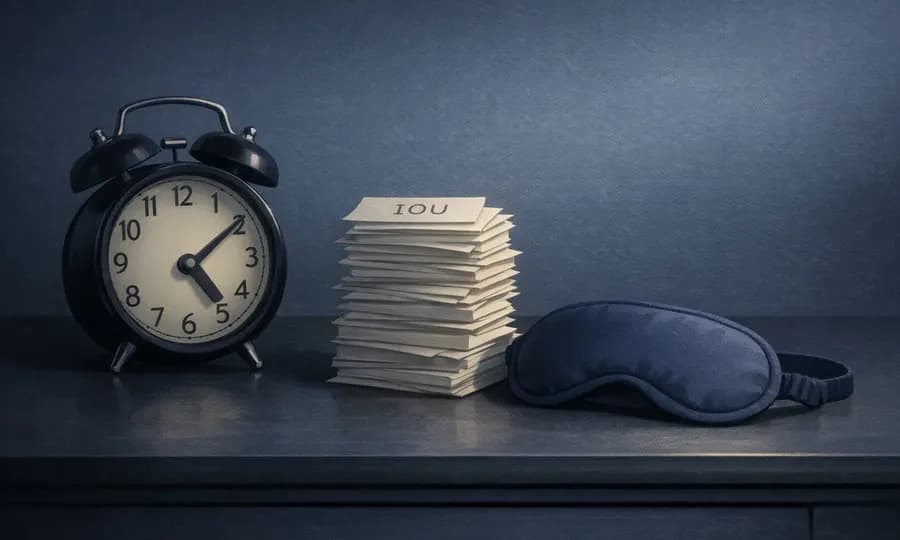
The room is dark. Caffeine moved earlier. The bedtime routine is steady. If the same sleep trouble keeps returning anyway, another habit tweak may not be the whole answer.
You already fixed the obvious stuff
Persistent trouble needs a wider look
The National Heart, Lung, and Blood Institute (2022) and Riemann et al. (2023) describe the clinical pattern as repeated difficulty falling asleep, staying asleep, or getting restorative sleep despite enough opportunity, with an effect on daily life. Edinger et al. (2021) advises clinicians not to use sleep-hygiene education by itself for chronic insomnia. This describes a clinical concept, not a label to apply to yourself.
Breathing pauses are not a habit signal
Frequent loud snoring paired with observed breathing stops, gasping, or choking is a warning pattern in guidance from the National Heart, Lung, and Blood Institute (2025) and Kapur et al. (2017). Kapur et al. (2017) also says questionnaires and prediction tools cannot diagnose obstructive sleep apnea without formal sleep testing. Take the pattern to a professional; do not try to settle it with a score.
Restless legs have a specific pattern
Allen et al. (2014) describes an urge to move the legs that starts or worsens at rest, eases temporarily with movement, and is worse in the evening or at night. Winkelman et al. (2025) notes that cramps, positional discomfort, neuropathy, and other conditions can look similar. That overlap belongs in a professional conversation, not a self-applied label.
The next step depends on the pattern
Riemann et al. (2023) recommends a clinical interview for persistent sleep difficulty and a sleep study when another sleep disorder is suspected; Kapur et al. (2017) places apnea testing after a comprehensive sleep evaluation. For chronic insomnia, Riemann et al. (2023) and Edinger et al. (2021) recommend multicomponent CBT-I as first-line care. This lesson does not teach its procedures.
Try this
Use two weeks as the appointment reminder
If the same sleep trouble has kept returning for about two weeks despite reasonable habit changes, book a routine appointment. Two weeks is a practical reminder to stop endless self-troubleshooting, not a diagnostic cutoff.
- Bring observed loud snoring with gasping or breathing pauses to a clinician (National Heart, Lung, and Blood Institute, 2025; Kapur et al., 2017).
- Bring a recurring evening urge-to-move pattern to a clinician rather than naming it yourself (Allen et al., 2014; Winkelman et al., 2025).
You do not need to enter a symptom or score in Rebuilt.
Key idea
Take the pattern. Leave the label.
Habits can support sleep, but they cannot identify why a problem keeps returning (Riemann et al., 2023; Kapur et al., 2017; Allen et al., 2014). A healthcare professional can assess the pattern. This lesson cannot tell you what it means.