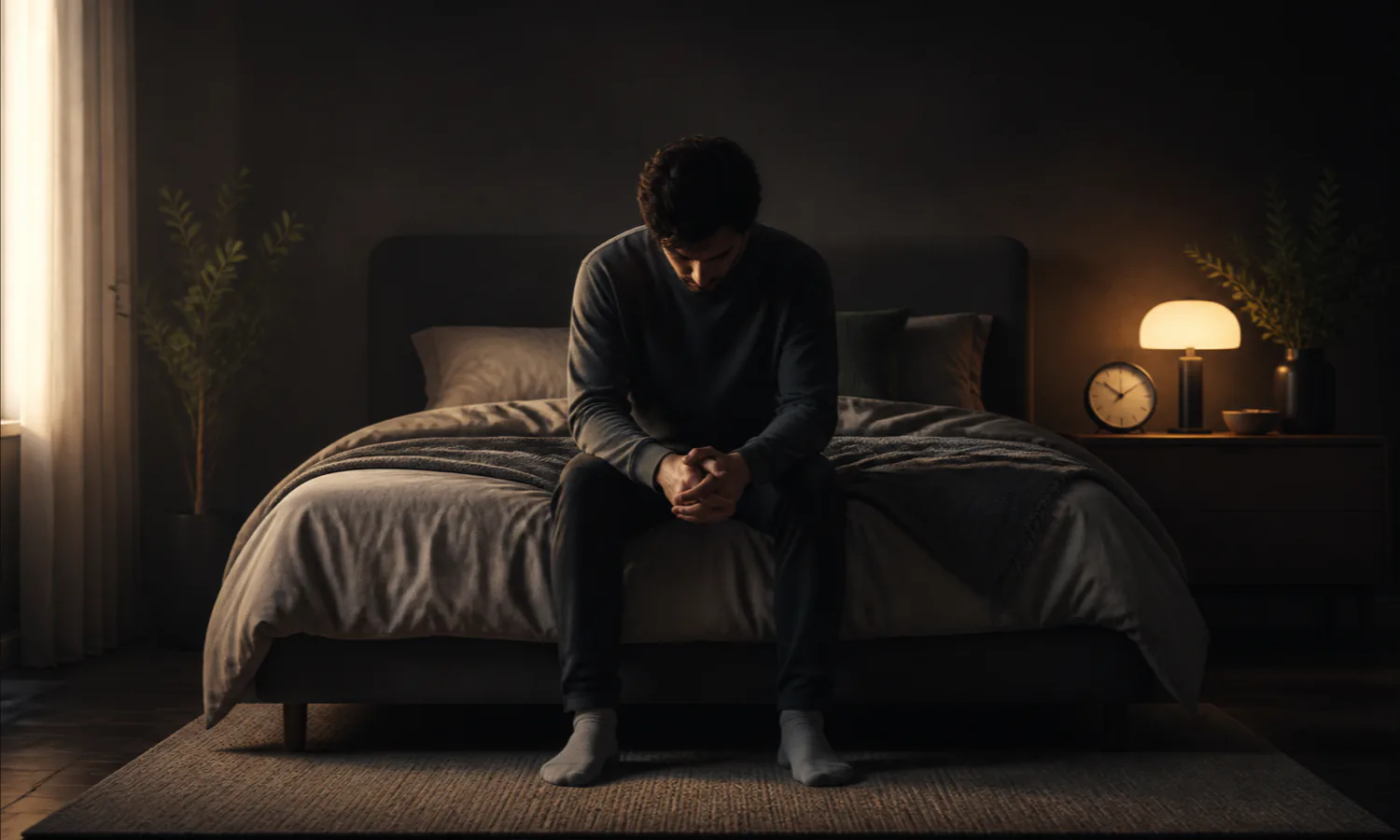
A full night is useful evidence, not a verdict
One long night may not erase several short ones, and hours in bed do not prove that sleep was uninterrupted or restorative. Start by checking pattern, timing, and daytime safety rather than trying to diagnose yourself from one tired morning.
The short answer - If this follows a run of short nights, give recovery more than one night. - If your schedule has shifted, return light, wake time, meals, and movement to a steadier rhythm. - If tiredness is persistent, unexplained, worsening, or affecting safe driving or work, bring it to a healthcare professional.
This guide is for adults and covers ordinary self-observation, not diagnosis. This is educational content. If you're experiencing symptoms, consult a healthcare professional.
First check whether “enough” was only last night
Sleep debt can build quietly. In a controlled study of healthy adults, Van Dongen and colleagues (2003) found that restricting time in bed to four or six hours for 14 nights produced cumulative attention deficits. Subjective sleepiness did not keep worsening at the same rate, which means people could underestimate how impaired they had become.
One recovery night helps, but it is not an eraser. Banks and colleagues (2010) tested different recovery opportunities after repeated restriction and found that several neurobehavioural measures improved without all returning to baseline after a single night. Those laboratory studies involved healthy adults under controlled conditions; they do not predict exactly how many recovery nights you personally need.
Try this question: over the last two weeks, not just last night, how often was your sleep opportunity shorter than usual? If the answer is “often,” use the [sleep debt guide](/lessons/sleep-debt) and protect several ordinary nights before judging the result.
Time asleep and restorative sleep are not the same thing
The CDC (2024) distinguishes sleep duration from sleep quality. Repeated waking, difficulty falling asleep, and feeling tired after enough time asleep are all reasons to look beyond the clock.
Do not turn that idea into a home diagnosis. The National Heart, Lung, and Blood Institute (2025) lists patterns such as frequent loud snoring, witnessed breathing pauses, gasping, and daytime sleepiness among possible sleep-apnea symptoms, and advises discussing symptoms with a healthcare provider. Riemann and colleagues' European guideline (2023) likewise places persistent sleep difficulty inside a clinical assessment rather than a checklist result.
Bring the pattern, not a label. If someone notices breathing pauses, if you repeatedly wake gasping, or if sleep remains unrefreshing despite reasonable opportunity, write down the plain observation and arrange a professional conversation. The companion guide [When It's More Than Habits](/lessons/when-its-more-than-habits) explains that boundary without asking you to store symptoms in Rebuilt.
Check the clock around sleep, not only the total
A night can be long and still sit awkwardly against your body clock. The CDC (2024) recommends consistent sleep and wake timing as one part of healthy sleep, while Riemann and colleagues (2023) note that a sleep history should examine timing and daytime effects, not duration alone.
For the next three days, keep one stable wake time if your life allows it. Get outdoor light after waking, eat at roughly familiar times, and avoid a dramatic lie-in followed by an unusually early bedtime. These are low-risk rhythm cues, not a treatment plan and not a promise that fatigue will disappear.
If you work nights, cross time zones, care for someone overnight, or have a schedule you cannot control, the advice needs adapting. A “perfect routine” is not the standard; a few repeatable anchors are.
Notice whether the problem is sleepiness, low energy, or both
Ordinary language often puts several experiences under “tired.” Sleepiness is the pull toward sleep: heavy eyelids, nodding off, or struggling to stay awake. Low energy can feel more like physical heaviness or reduced drive without an urge to sleep. These are descriptions for communicating clearly, not categories you should use to diagnose a cause.
The distinction changes today's safety decision. If you are fighting sleep, do not drive or do hazardous work. If you are awake but flat, lower the day's load and run the simple routine checks in this guide. If either experience is persistent or unexplained, a healthcare professional can evaluate the wider pattern.
The CDC (2024) lists feeling sleepy or tired after enough sleep as a sign of poor sleep quality and recommends professional advice for regular sleep problems. The NHLBI (2025) likewise includes daytime sleepiness and fatigue among possible sleep-apnea symptoms, but neither symptom identifies apnea on its own. One common feeling can have many explanations; that is precisely why the article stops at observation.
Try this
Give an ordinary recovery block a fair test
If there is a clear recent history of short sleep and no urgent warning sign, protect seven ordinary nights before adding exotic fixes. This is a practical experiment, not a clinical protocol.
- Keep wake time within roughly the same hour when life allows.
- Protect enough time in bed for your normal sleep need.
- Move caffeine earlier rather than increasing it through the afternoon.
- Get outside after waking and include gentle daytime movement.
- Keep alcohol from becoming a sleep strategy.
- Do not judge the block from night one.
Compare the week using functional clues, not a wellness score: Are you rereading less? Are routine tasks easier to start? Are you less likely to nod off? Banks and colleagues (2010) found that recovery after repeated restriction was incomplete after a single night in their laboratory study, which is why a multi-night view is more honest than expecting one lie-in to settle the question.
If the block changes nothing, do not keep tightening the routine indefinitely. Move the question to a professional rather than concluding that you need more discipline.
Try this
Run a three-day energy check without building a health diary
Use a temporary note for three days, then delete it. Do not enter symptoms, diagnoses, or clinical scores into Rebuilt.
- Sleep opportunity: Was there enough time for sleep across the whole week?
- Continuity: Did you wake repeatedly or spend a long time awake?
- Timing: Was wake time close to your usual time?
- Daylight: Did you get outside after waking?
- Fuel and fluids: Did you regularly skip meals or go most of the day without water?
- Movement: Did you spend nearly the whole day still?
Change only one or two obvious variables. A short outdoor walk, a regular first meal, or a steadier wake time is easier to interpret than a stack of supplements and hacks. If you have been inactive for a long time, use [How to Start Exercising After a Long Break](/lessons/how-to-start-exercising-after-a-long-break) for a conservative restart rather than trying to “sweat out” fatigue.
Try this
Know when the article stops being the right tool
Arrange a routine healthcare conversation when tiredness is persistent, unexplained, worsening, or repeatedly interferes with work, study, relationships, or basic daily tasks. Bring a list of medications or substances that may cause drowsiness and the plain sleep observations you have noticed; do not stop prescribed medication on your own.
Use urgent local medical help for severe or sudden symptoms rather than relying on this article. If you are fighting sleep while driving or doing safety-critical work, stop the task and move to a safe alternative. The National Highway Traffic Safety Administration (n.d.; accessed 2026-08-30) warns that coffee alone may not make a seriously sleep-deprived driver safe.
If this is clearly the day after one isolated poor night, the more useful next page is [How to Recover After a Bad Night's Sleep](/lessons/how-to-recover-after-a-bad-nights-sleep). If it keeps happening, do not keep escalating habit tweaks.
Try this
Bring a useful one-page summary to the conversation
A clinician does not need a perfect spreadsheet. Bring a short, temporary summary covering when the problem began, usual sleep and wake times, whether another person has noticed snoring or breathing pauses, how daytime functioning has changed, and any medications or substances that can cause drowsiness.
Include context that changed around the same time: shift work, travel, caregiving, illness, workload, a new prescription, or a major schedule change. Do not stop medication or start supplements based on this page. Riemann and colleagues (2023) recommend a clinical interview and sleep history for persistent sleep difficulty; useful observations help that conversation without turning you into your own diagnostician.
Keep health information private. Rebuilt does not need your symptom details or a sleep-disorder score.
Key idea
Use a sequence, not a scary list
Start here: look across the last two weeks for accumulated short sleep. Then check sleep continuity and schedule. Stabilise one or two ordinary daytime anchors for three days.
Escalate when needed: persistent or unexplained tiredness deserves a professional conversation, especially when sleep seems long enough or another person notices breathing pauses. This guide cannot tell you why you are tired, and it should not delay care.
Avoid the tempting shortcut of adding several supplements, extreme fasting, punishing exercise, or more stimulants at once. Those changes can create new effects and make the original pattern harder to interpret. A steady recovery block and a timely professional conversation produce cleaner information than a pile of self-experiments.
If your schedule or caregiving duties make a recovery block impossible, name that constraint when asking for help. Advice that assumes full control of your nights can miss the real problem. The next useful step may be practical support or workplace adjustment rather than another bedtime technique.
The goal is not to optimise every minute. It is to separate a recoverable rough patch from a pattern that has earned better help.